
Repair often makes sense when one failed part has stopped an otherwise reliable air conditioner. Replacement deserves a closer look when the repair is expensive and the system has other worn components or a history of breakdowns.
But either choice can leave you disappointed if the work overlooks why your home is uncomfortable. Leaking ducts, restricted airflow, or inadequate insulation can leave rooms hot even after new equipment is installed.
For Rocklin homeowners, the decision starts with identifying the problem. This guide explains when repair is worth the money, what replacement can improve, and when work on the home itself belongs in the project. You’ll also learn how heat-pump options, installation requirements, and expected energy costs affect the comparison.
Find Out Why Your Home Isn’t Cooling Properly
Before deciding whether to repair or replace your AC, have a technician inspect the system to determine what is wrong. An air conditioner that stops running may have a failed part. One that runs but leaves rooms hot may have a problem with cooling performance, airflow, or the house itself.
The inspection helps answer four questions:
- What needs repair? The technician identifies the failed part and checks for problems that may have caused it to fail.
- Is the AC cooling properly? Dirty coils, refrigerant problems, and other equipment faults can reduce its ability to cool your home.
- Is cooled air reaching the rooms? Restricted airflow or leaking ducts can leave rooms uncomfortable even when the AC is working.
- What condition is the rest of the system in? Repairing one part may be worthwhile when the remaining equipment is sound. Several worn or damaged components may make replacement worth considering.
Those findings give you a basis for comparing options: what the repair will fix, what it will cost, and whether other problems will remain.
When the Problem Extends Beyond the AC
If your AC runs but your home has always been difficult to cool, equipment troubleshooting may explain only part of the problem. Inadequate insulation or air leaks can allow heat into the house, adding to the work the AC must do.
Brower’s home-performance assessments investigate these broader concerns. Depending on the home and the problem, testing may include an infrared camera to identify temperature differences or a blower-door test to measure air leakage.
This assessment is separate from a standard AC repair visit. It can help determine whether improvements to the home should accompany—or could reduce the need for—equipment work.
Different Findings Lead to Different Repairs and Improvements
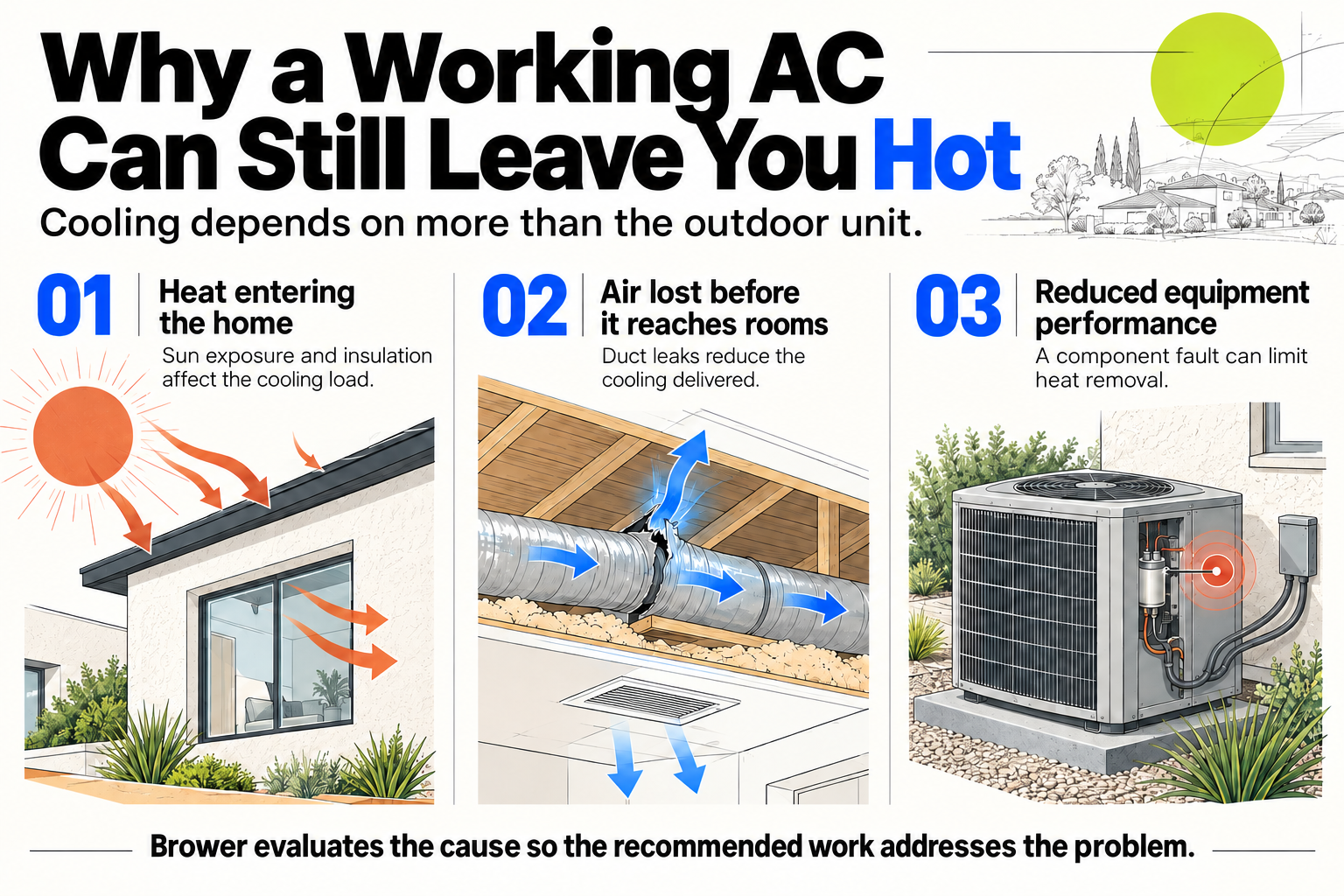
The same complaint, such as a house that stays too warm, can have several causes. Whether you decide to repair or replace, the work needs to address the cause identified during the evaluation.
| What the evaluation finds | Work that may help | What the work accomplishes |
|---|---|---|
| One failed part in otherwise dependable equipment | Repair the part and any problem that caused its failure | Restores operation while keeping usable equipment |
| Cooling reduced by dirt or restricted airflow | Cleaning, maintenance, or airflow corrections | Helps recover the existing system’s performance |
| Excess heat entering the home or cooled air leaking from ducts | Targeted insulation, air-sealing, or duct improvements | Reduces problems that can remain after AC replacement |
| Deteriorated equipment and documented problems with the home | Replacement combined with necessary home improvements | Addresses both the equipment and conditions limiting comfort |
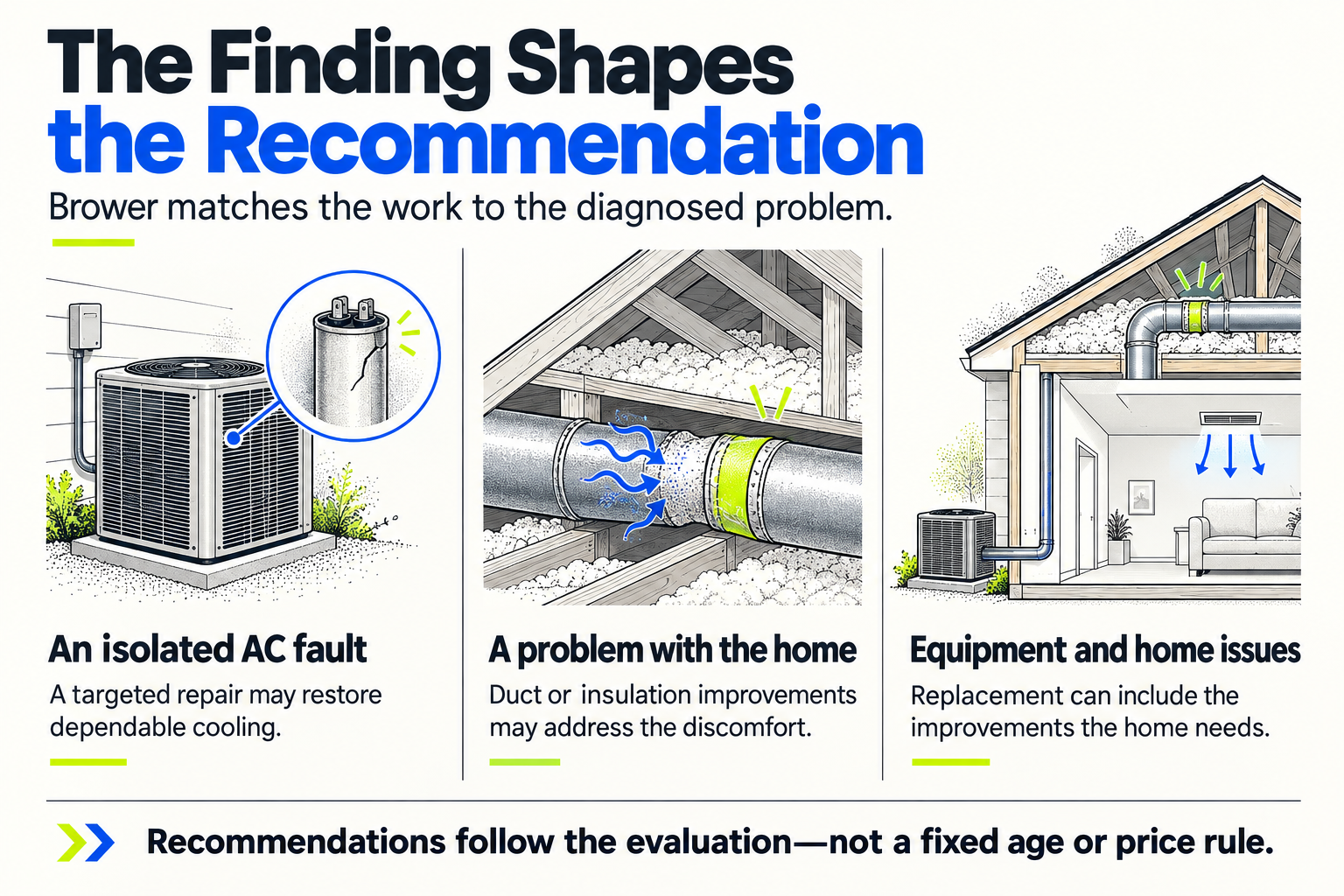
For example, a failed capacitor may stop the outdoor unit from running. Replacing it can restore operation. But if an upstairs room has always been hot because too little cooled air reaches it, that room may still need ductwork or airflow improvements.
Brower provides AC repair in Rocklin for equipment from all major brands, alongside services for ducts and insulation. That gives homeowners options for fixing the problems identified in their home.
When Repairing Your AC Makes Sense
If your AC was cooling your home well before it broke down, a repair may be all it needs. Replacing a failed electrical component or fan motor can restore cooling without the expense of a new system.
The decision depends on the repair cost and the condition of the rest of the equipment. Repair is easier to justify when the problem is isolated and the system has otherwise been reliable. If other major components are deteriorating or breakdowns have become frequent, it is worth comparing the repair quote with a replacement estimate.
Before deciding, check whether the repair qualifies for warranty coverage. A parts warranty may cover the replacement component while leaving you responsible for diagnosis, labor, or other charges. Ask for a repair total that reflects any confirmed coverage so you know what you would actually pay.
Is an Older AC Still Worth Repairing?
ENERGY STAR recommends considering replacement options for air conditioners more than 10 years old. Age alone, however, does not establish that replacement is the better investment.
An affordable repair may be worthwhile if the AC has been dependable and the remaining equipment is in good condition. It can keep your home cool while you plan and budget for eventual replacement.
Before approving the repair, ask whether the inspection found other worn or damaged components. Fixing one part will not prevent those problems from causing another breakdown. Although no inspection can guarantee the system’s remaining life, those findings help you judge whether another repair is worth the cost.
When Replacing Your AC May Be Worth the Cost
Replacement is worth considering when an expensive repair would leave you with a system that has other significant problems. Fixing the immediate breakdown may restore cooling, but repeated failures or additional worn components can make another large repair harder to justify.
A failed compressor or leaking indoor coil is a reason to compare repair and replacement estimates. These repairs can require substantial labor and refrigerant work. Warranty coverage may make repair more affordable, especially if the rest of the system is in good condition. Without that coverage, putting the money toward new equipment may offer better value.
The comparison should explain what each option would accomplish. Would the repair restore a system that otherwise meets your needs? Would replacement address recurring equipment problems or correct a system that is too large or too small for your home?
Replacing the AC alone may not resolve every comfort problem. If leaking ducts or restricted airflow contribute to hot rooms, the installation proposal should explain what additional work is needed. Understanding the full scope helps you judge whether the replacement is worth the investment.
Facing an expensive AC repair? Schedule an evaluation with Brower Mechanical to find out what needs fixing, what repair would cost, and whether replacement would better meet your home’s cooling needs.
How Insulation and Ductwork Affect the Replacement Decision
During Rocklin’s hot afternoons, heat entering through the roof, walls, and windows adds to the cooling your AC must provide. Reducing that heat gain can help the equipment keep your home comfortable.
Improving insulation or sealing air leaks can reduce that demand. When these improvements are part of the project, the equipment-sizing calculation should account for how the home will perform afterward. Simply copying the old unit's size may overlook those changes.
Brower offers insulation services and duct and equipment-sizing services. Its cooling-load calculations help determine how much cooling the home needs, taking the building and local conditions into account.
Getting Cooled Air to the Rooms That Need It
Leaking ducts can lose cooled air before it reaches the living space. Undersized ducts or restricted return airflow can also reduce performance. A new outdoor unit does not automatically correct these problems.
Zoning is another option in some homes, but it requires suitable equipment and duct design. Brower's home-zoning guidance explains that zoning does not guarantee energy savings and may not solve comfort problems caused by poor ductwork.
Some rooms may benefit from separate ductless equipment. Others may need corrections to the existing air distribution. The cause of the temperature difference helps determine which approach is appropriate.

Should You Replace Your AC With a Heat Pump?
If your AC needs replacement, you can choose another air conditioner or consider a heat pump that provides both cooling and heating. A heat pump cools your home much like an AC. During colder weather, it reverses that process to bring heat indoors.
Whether that added heating capability is worth the investment depends on how you heat your home now and which equipment you want to keep.
Keep Your Furnace or Switch to All-Electric Heating
A heat pump can work alongside a compatible gas furnace. In this arrangement, the heat pump provides cooling and some of the heating, while the furnace supplies heat when needed. The equipment and controls must be selected to work together.
An all-electric system uses the heat pump for heating and cooling without a gas furnace. This may require a new indoor air handler—the equipment that circulates air through the ducts—and electrical changes. Some homes need a panel upgrade, but that depends on the new equipment’s requirements and the home’s available electrical capacity.
Compare Heating Costs Along With Installation Costs
A heat pump changes how you heat the house, so the comparison needs to include winter energy costs. Replacing electric baseboards or an electric furnace presents a different savings opportunity from replacing gas heat. If you keep the gas furnace, estimated heating costs should account for when each system will run and the price of both electricity and gas.
Brower installs heat pumps in Rocklin, including ducted and ductless systems. An installation estimate can help you compare a conventional AC replacement with a heat-pump option, showing what equipment would stay, what would change, and the total cost of each project.
Compare the Full Cost of Repair and Replacement
Repair usually costs less upfront than replacement. To decide whether spending more on a new system is worthwhile, you need to understand what each price includes and what problems each option will solve.
A repair quote should explain which parts and labor are included, the cost after any warranty coverage, and whether other known problems will remain. A replacement estimate should identify the indoor and outdoor equipment being replaced, along with any necessary ductwork, electrical changes, permits, and testing.
These details also matter when comparing installation estimates. One price may cover equipment replacement alone, while another includes duct repairs needed to improve airflow. The difference in cost makes more sense when you can see the work included.
Include Permits and Required Testing
An AC replacement involves more than removing the old equipment and connecting the new system. Depending on the project, California’s energy code requires duct sealing and testing to verify that the installation meets applicable standards. Exceptions apply to some installations.
The replacement estimate should explain which permits, inspections, and tests your project requires and include their costs. Brower’s AC installation service includes permit handling and free installation estimates, helping you understand the proposed work before committing to replacement.
Compare Installation Costs and Expected Energy Savings
A more efficient AC can reduce the electricity needed to cool your home. However, its efficiency rating cannot tell you exactly how much your bills will fall. Summer temperatures, electricity rates, thermostat settings, and installation quality also affect what you pay.
If you are considering a heat pump that would replace some or all of your gas heating, compare the expected costs of both heating and cooling. A lower gas bill may come with a higher electricity bill. Any savings estimate should explain the expected change in your combined energy costs and the assumptions behind it.
If energy savings are a major reason for replacing the AC, ask for an estimate based on your current equipment, recent utility bills, and the proposed system. That helps you weigh the additional installation cost against potential savings, while keeping comfort and reliability improvements in the decision.
Compare Financing by the Total Amount Paid
Brower offers financing for HVAC and home-performance improvements, subject to credit approval and program terms. Financing can make a larger project more manageable by spreading payments over time.
The monthly payment tells you how the project fits your budget. The total repayment amount tells you what it will ultimately cost. Compare both, including any interest and fees, when weighing financing options.
Check Which Incentives Apply to Your Rocklin Home
Program resources reviewed October 28, 2026.
Rebates and other incentives may reduce the cost of qualifying improvements. Eligibility depends on the program and can include requirements related to your location, household income, and project.
Pioneer’s Incentive Finder helps homeowners identify potential programs using household information. Each result links to details about eligibility and how to apply.
Before subtracting an incentive from the installation price, confirm that your household and proposed equipment qualify, whether approval is needed before work begins, and when you would receive the money. A rebate paid after installation may lower the final cost while leaving you responsible for the full upfront payment.
If an incentive makes a heat pump look more affordable than a conventional AC, compare the complete installation prices after confirmed assistance. Include any indoor equipment, controls, or electrical work required for the heat-pump option.
AC Repair and Replacement Questions
Does R-410A Refrigerant Mean My AC Must Be Replaced?
No. Existing R-410A systems can continue to be used and repaired. EPA's refrigerant-transition guidance does not require replacement simply because an operating AC uses R-410A.
Extensive refrigerant repairs can still make replacement worth comparing. The repair cost and equipment condition matter; refrigerant type alone does not determine the answer.
Do I Have to Replace the Furnace With the AC?
Not necessarily. A furnace in suitable condition may remain, provided its blower and controls work with the new cooling equipment. The indoor coil must also be compatible.
Keeping a sound furnace can avoid an unnecessary expense. A furnace already needing major work creates a different comparison, because retaining it may leave another substantial project ahead.
Will a New AC Fix a Hot Upstairs Room?
It can help if the current equipment cannot provide enough cooling. It may not help if the room receives too little air or gains more heat than the system can reasonably remove without improvements to the home.
The replacement proposal should identify why the room stays hot and which work will address that cause.
Can a Home Assessment Show That I Do Not Need a New AC?
Sometimes. An assessment may identify duct, insulation, or air-leakage improvements that allow usable equipment to cool the home more effectively.
It can also show that replacement is still needed, with additional improvements necessary for good results. The assessment helps explain the options rather than guaranteeing a particular outcome.
Get a Clear Answer on AC Repair or Replacement
Before spending money on your AC, find out what will make your home comfortable again. A repair may be enough to restore reliable cooling. If replacement makes more sense, you should understand why—and whether ductwork or insulation problems also need attention.
Brower Mechanical has served Greater Sacramento homeowners since 1979, bringing expertise in both air conditioning and whole-home performance. We can identify what’s wrong, explain the recommended work, and help you compare the costs and benefits of your options.
Call (916) 259-5576 or schedule your cooling evaluation with Brower Mechanical to find out what your home needs. If you’re considering replacement, request a free installation estimate that explains what’s included and how the proposed system will address your cooling concerns.